
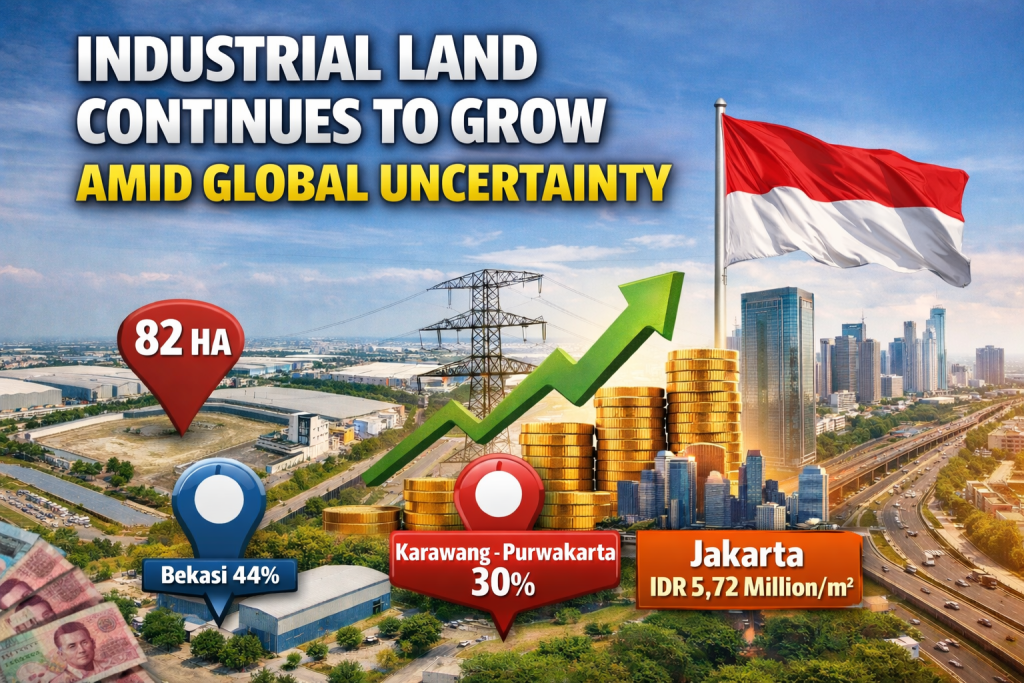
Despite ongoing global geopolitical uncertainty and fluctuations in the Indonesian Rupiah, Indonesia’s industrial land sector continues to demonstrate solid performance. In the fourth quarter of 2025, the industrial land market recorded an additional supply of 82 hectares.
Based on the Jakarta Property Market Insight Q4-2025 report by Leads Property Service Indonesia, total industrial land supply has now reached 13,932 hectares. This reflects that investor interest in the industrial sector remains resilient.
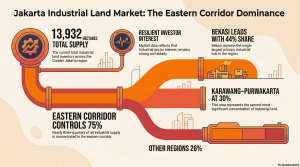
Bekasi, Karawang, and Purwakarta continue to serve as Indonesia’s primary industrial hubs. Bekasi accounts for 44% of total industrial land supply, followed by the Karawang–Purwakarta area with 30%. Overall, the eastern corridor controls nearly 75% of industrial land supply in Greater Jakarta.
Well-developed infrastructure and a mature industrial ecosystem are the main drivers behind strong investor demand in these areas, particularly for manufacturing, logistics, and data center developments.
The average industrial land price stands at IDR 3.12 million per square meter, marking a quarterly increase of approximately 2.5%.
Price breakdown:
-
Bekasi: IDR 3.42 million/m²
-
Karawang–Purwakarta: IDR 2.76 million/m²
Despite limited availability, Jakarta records the highest land prices at IDR 5.72 million/m². These high prices have encouraged investors to explore more affordable alternatives such as Serang (IDR 2.0 million/m²) and Cilegon (IDR 2.25 million/m²).
Looking ahead, the operation of the Japek II South Toll Road in 2026 is expected to shift investor interest further east, including areas such as Subang and Indramayu. These regions offer competitive raw land prices and lower minimum wages, making them attractive for cost-efficient industries.
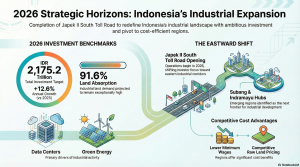
The government targets total investment of IDR 2,175.2 trillion in 2026, representing a 12.6% increase compared to 2025. Supported by strategic sectors such as data centers and green energy, industrial land absorption is projected to remain high at 91.6%.
Moving forward, industry players face a strategic choice: remain in core areas such as Bekasi–Karawang to leverage established ecosystems, or expand into emerging regions to achieve long-term cost efficiency.
Source : KOMPAS